
Digital Twins Are Growing Fast — Why the Market Now Needs Consolidation

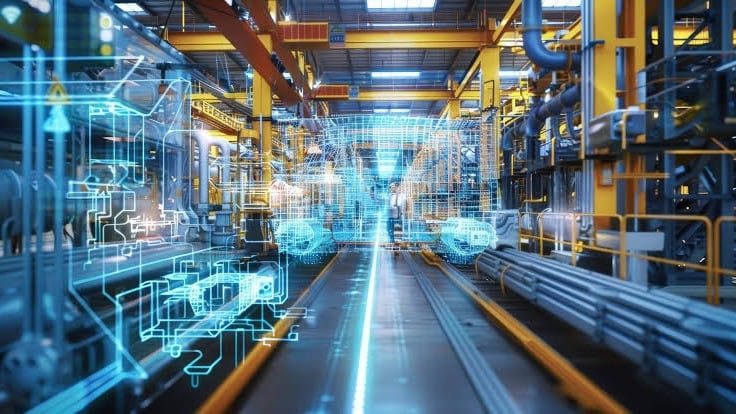
The Digital Twin (DT) market is moving from promise to proliferation. Once confined to aerospace and manufacturing, twins are now being applied across energy systems, buildings, cities, and even national infrastructure.
Analysts place the current global market between USD 17 billion and 25 billion, rising to USD 250–470 billion by 2034, with annual growth of 30–40 percent. That makes it one of the fastest-growing technology domains — now approaching the combined size of the CAD and PLM sectors, yet expanding nearly ten times faster, and even outpacing the historically high-demand gaming industry (12–14 percent CAGR).
Yet beneath this extraordinary growth lies a less visible truth: the ecosystem remains deeply fragmented — and that fragmentation is holding back cooperation, scalability, and cost efficiency.
Fragmentation and Its Consequences
Digital twins today exist in isolation. Each sector — manufacturing, energy, transport, construction, healthcare, or cities — has evolved its own technology stack, data standards, and integration tools.
Research reveals the scale of this issue:
• 70 percent of DT projects require bespoke middleware or connectors just to bridge incompatible systems (Deloitte 2024).
• 60 percent of budgets are consumed by data preparation and cleaning rather than analysis (Capgemini Engineering 2023).
• Only 15 percent of organisations, according to Gartner, maintain a unified, cross-domain model connecting physical assets, simulations, and enterprise systems.
The World Economic Forum–CAICT "Digital Twin Cities" framework echoes this challenge, warning that:
In other words, the digital twin of a transport network cannot yet meaningfully exchange data with the twin of its energy grid or building portfolio. Each operates as an intelligent but isolated island.
A Diversity of Definitions
Part of the problem is conceptual. "Digital twin" can mean very different things depending on who you ask. In manufacturing, a twin is a physics-based replica used for predictive maintenance. In product engineering, it is a virtual prototype embedded in the PLM lifecycle. In construction, it often refers to the integration of BIM, IoT, and GIS models for asset management. And in the urban context, it becomes a city-scale platform combining traffic, environmental, and social data.
The recent arrival of gaming and visual-simulation engines — including Unreal Engine, Unity, and NVIDIA Omniverse — has added yet another layer of diversity. These tools bring extraordinary realism and interactivity but introduce their own data formats, rendering pipelines, and synchronisation methods.
Innovation, therefore, is accelerating — but interoperability is falling behind.
The Hidden Complexity: Data Preprocessing
Beneath all these variations lies a universal bottleneck: data preprocessing.
A digital twin is only as good as the data that sustains it. Raw telemetry from thousands of sensors — temperature, vibration, power flow, occupancy, or pressure — arrives in different formats, frequencies, and quality levels. Without a structured, automated way to process it, the resulting twin becomes unreliable or inconsistent.
Preprocessing is where a twin's intelligence begins. It involves several technical stages:
• Acquisition and filtering — ingesting data from multiple protocols such as OPC UA, MQTT, Modbus or CoAP, and removing noise or duplicates at the edge.
• Normalisation — aligning units, timestamps, and coordinate systems so that all data can be meaningfully compared.
• Validation — applying logical and physical constraints to detect anomalies (for example, flagging an implausible sensor value or missing timestamp).
• Semantic enrichment — tagging data with contextual information — location, asset identity, or system function — so that analytics tools can interpret it correctly.
Why Consolidation Is Essential
The fragmentation of today's twin landscape — across industries, protocols, and semantics — is reminiscent of the early days of CAD. In the 1980s, engineers struggled to share designs because each CAD tool used its own proprietary format. It was only through standardisation — STEP, IGES, and later open APIs — that design collaboration became possible.
Digital twins are now at the same inflection point. Without common infrastructure and interoperable data foundations, each project remains a bespoke experiment. Consolidation, therefore, is not about restricting innovation — it is about creating shared reliability.
A consolidated approach would bring four clear benefits:
• Speed, through reusable, validated data pipelines.
• Affordability, as integration and maintenance costs fall.
• Security, via unified governance and Zero-Trust data exchange.
• Scalability, allowing cross-domain collaboration — between city systems, industrial assets, and the energy grid.
The WEF–CAICT framework explicitly advocates this path, calling for modular, open architectures underpinned by robust data infrastructure.
Altior: Building the Data Foundation
Consolidation begins with data — and this is where Altior provides the enabling layer.
Altior serves as a data-infrastructure platform for digital twins, managing the end-to-end lifecycle of telemetry from acquisition to delivery. Its architecture is designed to handle the most technically demanding requirement of modern twins: continuous, validated, real-time data flow.
Altior's core capabilities include:
• Multi-protocol ingestion, integrating diverse industrial and urban telemetry through OPC UA, MQTT, DLMS/COSEM, Modbus, LoRa, and BACnet.
• Real-time preprocessing, with edge filtering, timestamp alignment, and unit normalisation performed before data enters the central twin model.
• Semantic mapping, linking sensor streams to BIM, GIS, and enterprise metadata according to standards such as ISO 30173 and ISO 23247.
• Hybrid edge–cloud orchestration, distributing workloads intelligently to reduce latency and optimise bandwidth.
• Governance and security, providing encryption, access control, and audit trails aligned with ISO/IEC 25010.
• Open APIs, ensuring that data can be consumed by any analytics or twin platform — rather than locking users into a single vendor ecosystem.
In practice, Altior transforms the "plumbing" beneath digital twins into a reusable, federated service. It systematises the way validated, secure data is ingested, normalised, and distributed — the very process that today absorbs most of a twin's cost and effort.
From Fragmentation to Federation
The next phase of digital-twin maturity will be federation rather than homogenisation. Different twins — in manufacturing, cities, or infrastructure — will remain domain-specific. But with a shared data foundation, they will be able to cooperate, exchange information, and form higher-order systems that deliver new insights.
Altior operationalises that theory in production environments — unifying telemetry, governance, and semantics into a continuous, trusted data fabric.
Conclusion
The Digital Twin market is growing at unprecedented speed — approaching the scale of CAD and PLM, expanding nearly ten times faster, and even surpassing the traditionally high-growth gaming sector.
But growth alone is not maturity. Without consolidation, the industry risks replicating the inefficiencies of its early years: incompatible systems, duplicated effort, and fragile architectures.
To move forward, digital twins must evolve from visualisations into living, federated systems built on trusted, interoperable data infrastructure. That is the step from fragmentation to federation — and it is the layer that Altior is purpose-built to provide.