Inkwelldata

Inkwelldata

Altior’s Distributed Node Architecture: Rethinking Industrial Infrastructure for Reliability, Sovereignty and Scale
industrial ai

Altior’s Distributed Node Architecture: Rethinking Industrial Infrastructure for Reliability, Sovereignty and Scale

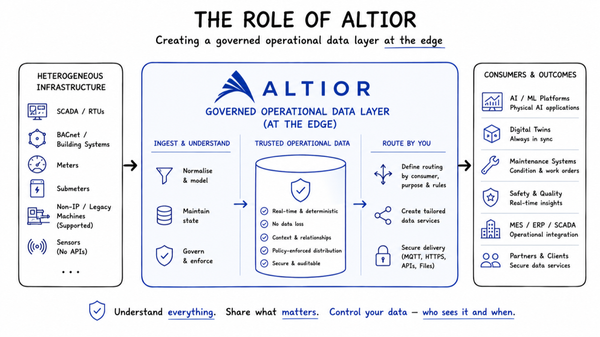
Industrial infrastructure is becoming more distributed, more regulated and more dependent on trusted operational intelligence. Most industrial digital infrastructure follows a deeply centralised architectural model. Operational sites generate telemetry, transport it to central platforms or cloud environments, and rely on those central systems to reconstruct operational meaning, apply governance, and
5 min read
Sovereign Cloud and Sovereign Operational Data: A Complementary Architecture for Europe and the Middle East
digital sovereignty

Sovereign Cloud and Sovereign Operational Data: A Complementary Architecture for Europe and the Middle East

Sovereign cloud infrastructure is only part of the sovereignty architecture. The operational data layer matters just as much. Europe and the Middle East are investing heavily in sovereign cloud infrastructure, sovereign AI capability and nationally governed digital ecosystems. Across Europe, providers such as STACKIT, OVHcloud, Scaleway and Nscale are establishing
5 min read
The Cloud Is Not Enough: AI Execution in the OT Layer for Industry 4.0
AIoT

The Cloud Is Not Enough: AI Execution in the OT Layer for Industry 4.0

Artificial Intelligence is changing the enterprise, particularly in domains where data is centralised, such as software development, documentation, and enterprise knowledge systems. In these environments, data is structured and easily accessible. It can be aggregated, processed asynchronously, and acted upon without immediate operational consequences. Cloud-based architectures align well with these

4 min read
From Periodic Compliance to Continuous Oversight: Monitoring-as-a-Service for Water and Heat Meters in 2026
smart metering

From Periodic Compliance to Continuous Oversight: Monitoring-as-a-Service for Water and Heat Meters in 2026

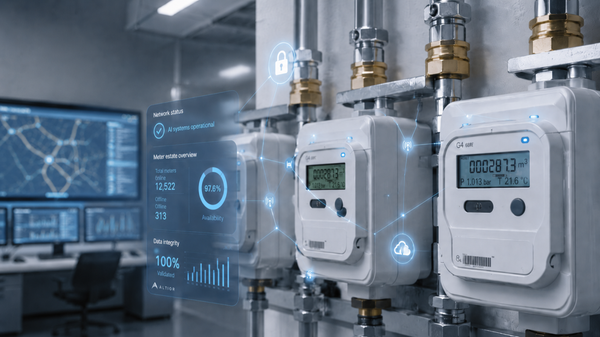
Across Europe, water and heat metering has moved from infrastructure deployment to infrastructure governance. Statutory verification cycles and sampling procedures continue to underpin regulatory assurance. They remain fundamental to billing integrity and consumer protection. Yet the context in which they operate has changed materially. Smart water and heat meter estates
5 min read
The UK Electricity System: Supporting Operability Through Operational Data Infrastructure
electricity markets

The UK Electricity System: Supporting Operability Through Operational Data Infrastructure

The UK electricity system is undergoing a substantial transformation. Generation is becoming more decentralised, flexibility is increasingly important to system balance, and operational responsibility is being shared across a wider range of actors. The establishment of the National Energy System Operator (NESO) reflects this shift and provides the institutional framework
3 min read
Governing the OT Data First Mile - Simple Deployment, Secure Control, and Scalable Enterprise Intelligence
OTData

Governing the OT Data First Mile - Simple Deployment, Secure Control, and Scalable Enterprise Intelligence

Across industry, organisations are investing heavily in enterprise platforms for analytics, digital twins and artificial intelligence. These platforms promise better decisions, improved efficiency and, increasingly, autonomous or "agentic" operations that can respond dynamically to changing conditions. Yet many programmes struggle to move beyond pilot. When initiatives stall, the
5 min read
What Regulators Are Signalling About AI in Operational Technology – and How Altior Enables Secure Digital Twin Deployment at Scale
cybersecurity

What Regulators Are Signalling About AI in Operational Technology – and How Altior Enables Secure Digital Twin Deployment at Scale

Across energy, utilities, transport, and industrial infrastructure, organisations are proceeding carefully with artificial intelligence in operational technology (OT) environments. This caution is not a lack of ambition. It reflects a growing alignment between industry experience and regulatory concern. AI systems interacting with physical infrastructure introduce risks that cannot be addressed
4 min read