
Altior: Rethinking Push Architecture for Industrial IoT

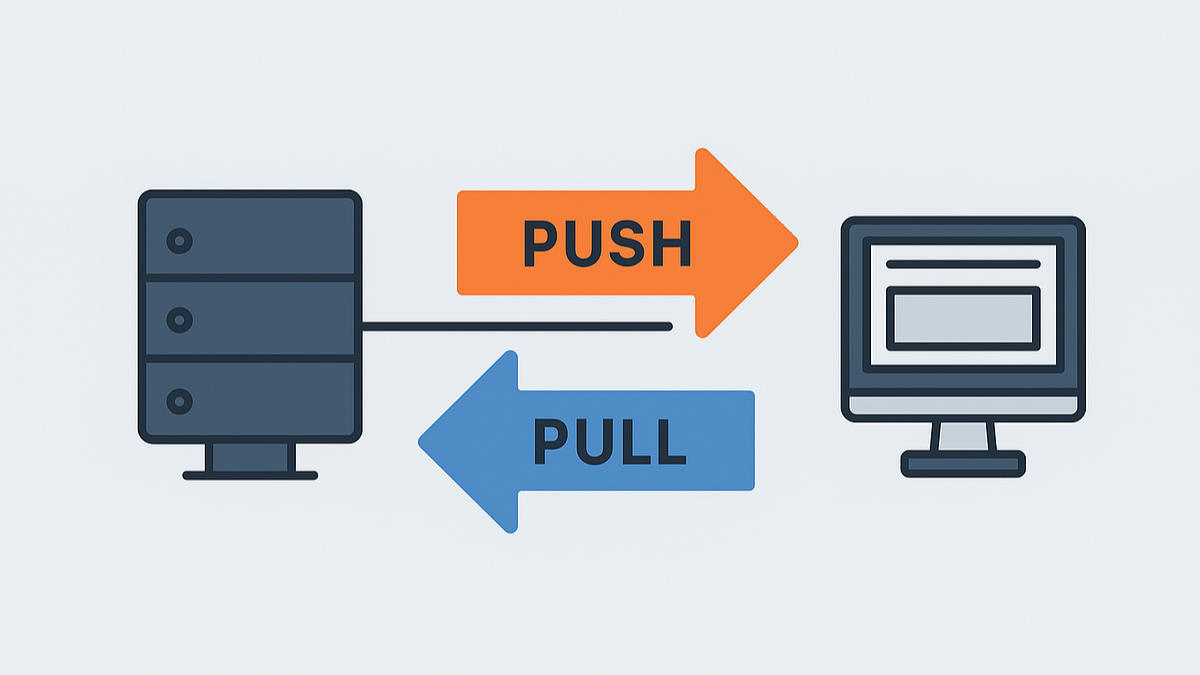
Why pushing operational state, not just messages, is becoming the next evolution of industrial data architecture.
Every industrial system has the same fundamental challenge: moving information from physical assets to the applications that need it.
Historically, this has been achieved through a pull architecture. Applications periodically ask devices or operational systems for their latest state. A SCADA platform polls a PLC. A historian collects measurements. An analytics platform queries the historian. Dashboards query the analytics platform.
Each application pulls the information it needs.
This approach has served industry well for decades because it is simple, deterministic and supported by many industrial protocols. But as operational estates have grown, so has the cost of continuously asking the same question.
Every request consumes network bandwidth, compute, storage, API capacity and security controls, even when nothing has changed.
More importantly, every new application creates another consumer: another dashboard, another analytics platform, another integration and, increasingly, another AI agent.
The number of requests can grow much faster than the number of physical assets.
Why the industry is moving towards push
For this reason, industrial architectures are steadily moving towards push.
Instead of applications repeatedly asking for information, operational systems publish updates when something meaningful changes. This reduces unnecessary traffic, lowers latency and improves scalability. Rather than waiting for the next polling cycle, events can be delivered immediately.
The result is lower infrastructure cost, lower network utilisation and faster operational response.
Today, report-by-exception, MQTT, OPC UA subscriptions, BACnet Change of Value notifications and other event-driven approaches are becoming standard practice across industrial IoT.
But pushing data is only part of the answer.
Why pushing messages is not enough
Most push architectures still operate at the transport layer.
An MQTT broker, for example, is extremely effective at moving messages between producers and consumers. It receives information, routes it efficiently and delivers it to subscribers.
What it does not do is maintain operational state.
A broker may retain the last payload received on a topic, but that is not the same as maintaining a live representation of the asset. Even where payloads carry richer definitions, the broker’s responsibility is still to relay them. The interpretation, validation and operational meaning sit outside the broker.
Altior operates one architectural layer above.
Every update, whether obtained through polling, subscriptions or native publish mechanisms, is validated, decoded and applied to a continuously maintained digital twin of the physical asset. The twin maintains current and derived state, applies business logic, governance and security policies, and determines whether a meaningful operational event has occurred.
Only then is information published.
What Altior pushes is therefore not simply another message. It is a trusted change in operational state.
Better data for AI
This distinction becomes increasingly important as industrial AI moves into production.
AI systems do not benefit from endless streams of repetitive telemetry. They require trusted operational context.
Without that context, every downstream application or model must repeatedly clean, correlate and interpret raw data before it becomes useful.
Altior moves that intelligence closer to the operational edge.
Operational state is validated, enriched and contextualised before it is exposed to downstream systems. AI platforms receive meaningful operational events rather than millions of repetitive measurements.
The result is simpler data pipelines, lower infrastructure costs and faster operational insight.
The effect compounds at scale
The architectural advantage becomes more pronounced as operational estates become more complex.
Polling architectures scale with the number of devices and the frequency of requests. Broker-based report-by-exception architectures improve on this by reducing upstream traffic to meaningful changes.
Altior takes the next architectural step by decoupling consumption from acquisition.
Once operational state is maintained within a live digital twin, applications, dashboards, enterprise systems and AI agents can consume that state without communicating directly with the physical asset.
Adding another dashboard, digital service or AI agent no longer increases load on the operational network. The twin absorbs the read pressure.
This matters most in two situations.
The first is heterogeneity. Industrial estates rarely consist of a single protocol or vendor. They combine Modbus, wired and wireless M-Bus, LoRaWAN, OPC UA, BACnet, MQTT and proprietary interfaces accumulated over many years.
The more heterogeneous the estate becomes, the greater the value of normalising those technologies into a single operational model.
The second is consumer fan-out. As organisations deploy increasing numbers of AI agents, digital twins, analytics platforms and operational applications, the number of consumers grows faster than the number of physical assets.
Architectures that scale with requests become increasingly constrained. Architectures that serve consumers from maintained operational state avoid adding that demand to the asset estate.
This is where the architectural advantage compounds.
Security improves by design
The same architecture also strengthens cyber security.
Traditional application-led polling creates numerous communication paths between operational assets and consuming systems. Every connection must be authenticated, monitored and secured. As integrations multiply, so does the attack surface.
Altior reduces that exposure.
Where protocols require polling, polling remains local to the edge. Where devices support native publish mechanisms, those capabilities are used directly.
Either way, consuming applications never communicate directly with operational assets. Instead, they subscribe to governed operational events or query the digital twin through controlled interfaces.
Security policies are evaluated before information leaves the twin, rather than being implemented independently by every consuming application.
This aligns naturally with defence-in-depth and the principles behind IEC 62443, NIS2 and Zero Trust:
Security becomes an architectural property rather than an application-by-application responsibility.
Building on existing systems
None of this requires replacing existing operational technology.
Most organisations have invested heavily in SCADA platforms, building management systems, historians, PLCs, IoT platforms and enterprise applications. These systems continue to perform valuable operational functions.
Altior is designed to sit alongside that existing infrastructure rather than replace it.
Where devices already publish events, Altior consumes them. Where devices must be polled, Altior contains that polling locally.
Existing SCADA systems continue supervising operations. Historians continue storing measurements. Enterprise platforms continue running business processes.
The difference is that every consuming system now works from the same trusted operational state rather than independently interrogating the underlying assets.
Complexity is not eliminated. It is relocated into a governed operational data layer where protocols, security, business logic and operational state are managed once and exposed consistently across the organisation.
This allows organisations to modernise incrementally, site by site and application by application, while protecting previous investments.
It is an evolution of industrial architecture rather than a replacement programme.
Looking ahead
Industrial AI is changing the economics of operational data.
The challenge is no longer connecting assets. It is enabling an ever-growing number of applications, digital services and AI agents to consume trusted operational information without continuously increasing infrastructure cost, operational complexity and cyber risk.
That is why the next generation of industrial architecture will not be defined simply by whether data is polled or pushed.
It will be defined by what is being pushed.
Message brokers push messages.
Altior pushes governed operational state.
That distinction becomes increasingly valuable as operational estates become more heterogeneous, more connected and more AI-driven.
The more complex the estate and the greater the number of systems consuming its data, the greater the benefit of decoupling consumption from acquisition through a live, stateful digital twin.
That is the architectural foundation on which the next generation of Industrial IoT will be built.