
Physical AI Needs an Operational Data Layer. The Architecture You Choose Decides Who Controls It

Physical AI is moving steadily from research into industrial operations.
Across manufacturing, mining, energy and utilities, organisations are developing systems that can perceive physical conditions, interpret operational context and support or automate decisions in real time. The potential benefits are substantial: safer operations, higher productivity, better asset utilisation and more resilient infrastructure.
Most deployments still begin with individual use cases: predictive maintenance, quality inspection, autonomous vehicles, energy optimisation or computer vision. This is sensible, but it can create a structural problem when every project introduces its own integration, data model, cloud pipeline and governance rules.
A pilot may succeed technically while contributing little to the wider operating environment.
Every model, application and automation service needs access to trusted operational data, consistent context and governed interfaces.
That is the role of the operational data layer.
Successful pilots still need a shared foundation
Specific use cases remain the right place to begin, but each deployment should strengthen a reusable operational architecture.
A quality-inspection project should improve the common asset model and data lineage. A maintenance project should create reusable device integrations and state definitions. A warehouse deployment should establish security, identity and routing patterns that can support future applications.
Without that common foundation, organisations accumulate separate systems with:
The result may be several successful pilots, each requiring substantial new integration work.
The objective should be to make the second deployment easier than the first, and the third easier again. What the operational data layer must provide
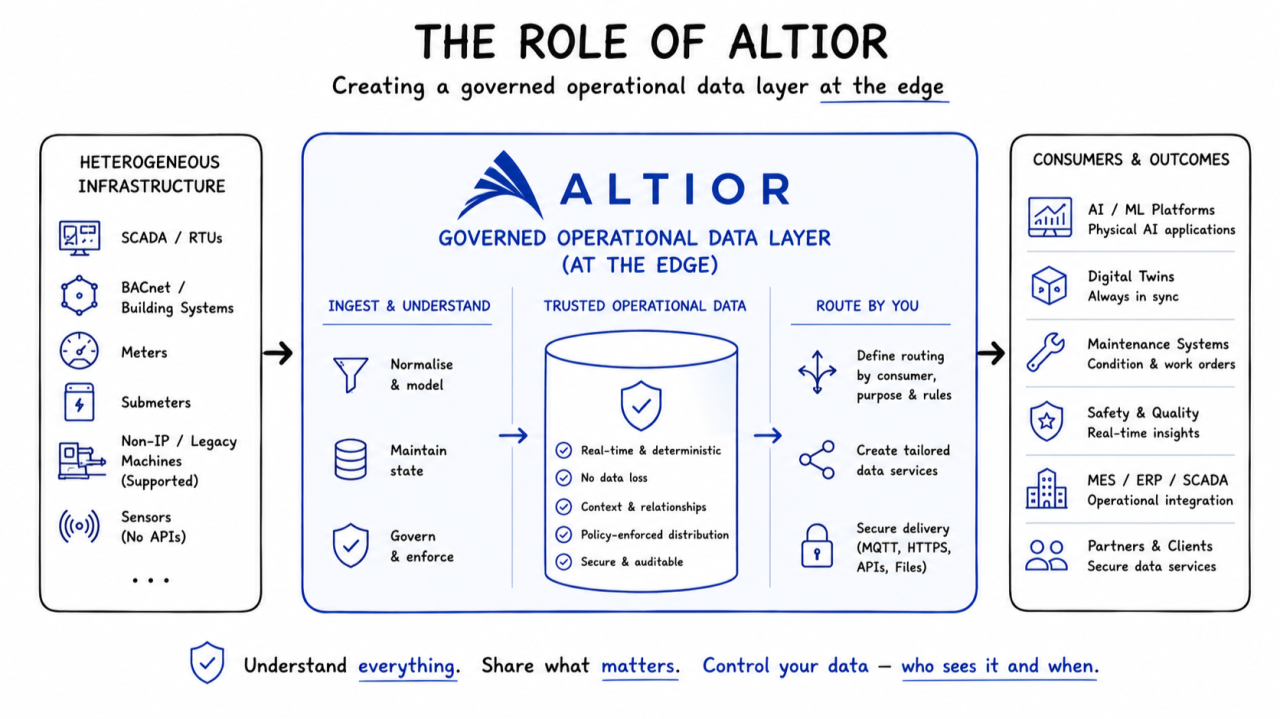
A governed operational data layer sits between heterogeneous infrastructure and the applications that use its data.
Its role is to:
For Physical AI, this layer is essential because raw telemetry alone is insufficient.
The model also needs to understand:
The operational data layer provides the context that allows perception, reasoning and action to operate as one reliable system.
Control of the layer determines data sovereignty
Once the operational data layer becomes the common interface between physical infrastructure and digital applications, its ownership becomes strategically important.
Who defines the asset model?
Who determines what constitutes a change of state?
Who controls routing and access policy?
Which data is allowed to leave the site?
Where is operational history stored?
Who may use the data to train or operate models?
Can the organisation move to another platform without rebuilding its operational estate?
These questions determine operational control, commercial dependency and data sovereignty.
Physical AI may rely on sensitive information about asset configuration, production behaviour, network performance, maintenance patterns, engineering limits and failure modes.
Data sovereignty therefore involves more than the location of a server. It includes control over:
The architecture of the operational layer determines how much of that control remains with the infrastructure owner.
The conventional ingestion architecture
Most industrial data architectures follow a broadly similar pattern.
Connectors collect data from machines, sensors, controllers and applications. The data is translated, normalised, contextualised, published into a broker or unified namespace, stored and then made available to downstream systems.
This architecture has made a major contribution to industrial digitalisation. It can reduce point-to-point integration, establish common data structures and make operational information available to analytics, digital twins, MES, ERP and AI platforms.
Its scaling characteristics require careful consideration.
In many implementations, every observation is ingested, transmitted and stored before a downstream application determines whether it has operational significance.
Across a large estate, this can create:
This approach remains appropriate where comprehensive telemetry collection is required. Physical AI, however, also needs a reliable and current understanding of operational state.
That requirement supports a more selective approach upstream.
Maintaining state before distributing events
A state-aware operational layer maintains a continuously updated representation of every connected asset.
Each new observation is interpreted against the asset’s current condition and operating model.
The platform can then determine:
When nothing meaningful has changed, the current state can remain synchronised without sending another redundant observation to every downstream system.
Consumers receive the information required for their purpose, while the operational layer continues to monitor the physical estate continuously.
For large fleets of machines, meters and sensors, this can reduce:
It can also improve signal quality. AI systems receive operational events with verified state, context, provenance and policy attached, rather than an undifferentiated stream of readings.
Governance belongs in the data path
As Physical AI begins to influence physical operations, governance must be applied before data reaches the model or application.
Every operational event may need to preserve:
This allows downstream systems to understand both the event and the basis on which it may be trusted and used.
Different consumers can then receive different, authorised views of the same physical estate.
The infrastructure owner retains control over what is shared, who sees it, why it is shared and when.
How Altior provides the operational layer
Altior is Inkwell Data’s implementation of a governed operational data layer.
It connects heterogeneous industrial and infrastructure systems, maintains the current state of each connected asset and distributes authorised operational events to existing applications and platforms.
Its role is to enable AI, digital twins, MES, ERP, SCADA, maintenance systems, analytics platforms and regulated data services to work from the same trusted operational foundation.
Continuous status monitoring
Altior maintains a live operational representation of every connected asset.
Incoming observations are interpreted against the asset’s current state, relationships and engineering model. The platform can identify changes, exceptions and conditions requiring action.
Push-first, event-driven delivery
Relevant changes are distributed to the systems that need them.
This reduces repeated polling and unnecessary downstream traffic while preserving a current operational view of the estate.
Policy-controlled routing
Routing can be defined by consumer, purpose, location, sensitivity and operational rule.
Different applications receive the subset of data relevant to their role, with the appropriate context and policy attached.
Governance and lineage
Identity, provenance, validation, authorisation and lineage are applied as data is interpreted and routed.
The receiving system therefore obtains both operational information and an auditable record of where it came from, how it was processed and why it was shared.
Deployment flexibility
Altior can run at the edge, on premises, in a private or sovereign cloud, in a public cloud or across a hybrid architecture.
Organisations can place processing and storage according to operational latency, resilience, security and sovereignty requirements.
Altior Studio
Altior Studio provides a visual environment for defining device integrations, operational models, routing policies and tailored services.
Engineers and operators work with reusable building blocks rather than creating a separate software pipeline for every device, destination or use case.
Altior manages the underlying complexity of:
Already-digitalised device families can be exposed in minutes. New device types can typically be operationalised in hours. More complex equipment can be integrated in days rather than months.
The same integration and operational model can then be reused across sites, customers and services.
Enabling the existing technology estate
A governed operational data layer allows organisations to make fuller use of the systems in which they have already invested.
Altior supports all these systems by providing a consistent operational layer beneath them.
This allows organisations to add new Physical AI services without repeatedly rebuilding the connections to the physical estate.
Engineering and economic effects
The benefits accumulate as the operational layer is reused.
The first use case establishes the asset model, integration, identity and policy.
Later applications can reuse those components rather than creating another complete pipeline.
This can reduce:
It also supports a controlled progression from monitoring and decision support towards bounded automation.
Organisations can introduce greater autonomy as data quality, governance, operational confidence and workforce capability mature.
Building the layer while proving value
Physical AI should begin with specific operational problems where value can be measured.
Those deployments should also contribute to a common operational data layer that the organisation understands and controls.
Each project should improve the shared asset model, integrations, policies, lineage and reusable services.
This avoids delaying progress in pursuit of a perfect enterprise architecture, while ensuring that successful pilots do not remain isolated.
Physical AI requires perception, trusted context, timely processing and safe action.
The operational data layer connects those capabilities.
Its engineering determines reliability, scalability and cost.
Its governance determines how data may be used.
Its ownership determines who controls the intelligence built upon it.