
A Single Data Fabric for the Water Cycle

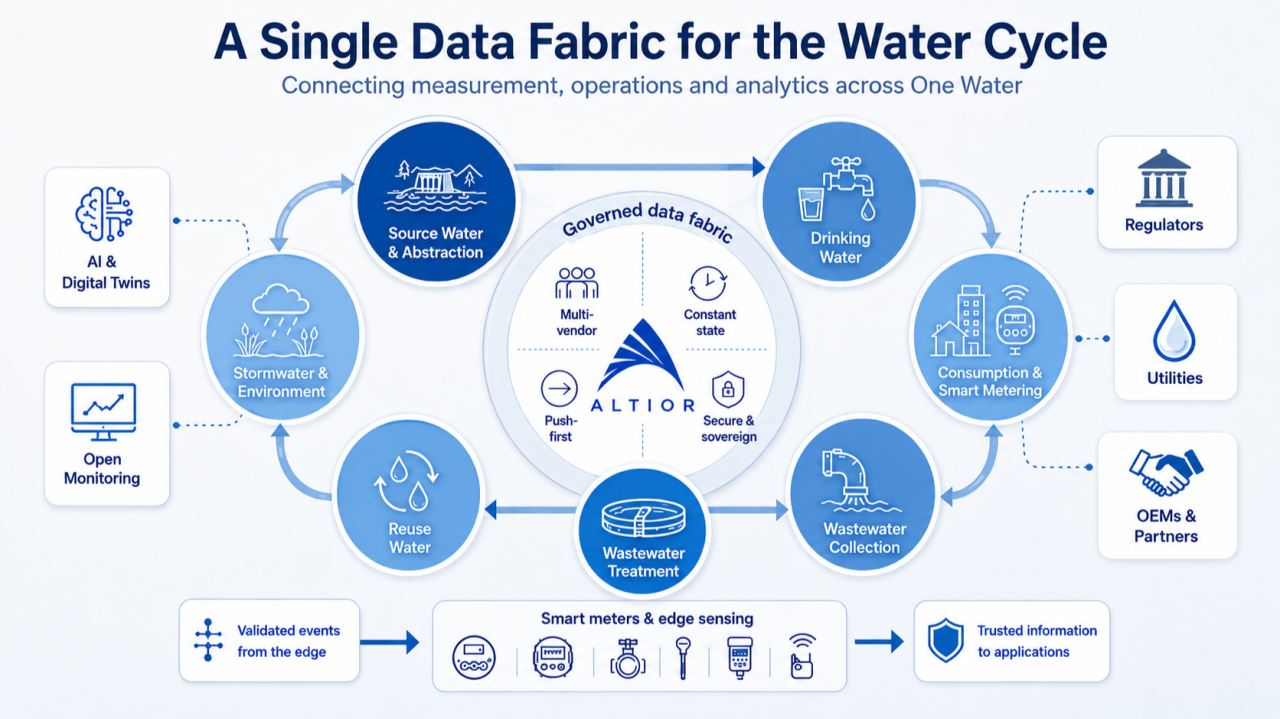
Water systems have historically been organised around infrastructure boundaries.
Drinking water is managed in one part of the utility, wastewater in another, with stormwater, catchments and reuse often treated separately again. Each domain has developed its own teams, suppliers, control systems and data environments.
That structure reflects how assets were built and regulated. It increasingly fails to reflect how the water cycle actually behaves.
Drought resilience depends on understanding abstraction, storage, leakage and customer demand alongside the availability of alternative supplies from treated wastewater. Storm-overflow performance depends not only on sewer capacity, but also on rainfall, catchment conditions and the state of treatment assets. Reuse depends on matching treatment output with real demand across industrial, agricultural and municipal users.
These are not separate problems. They are interdependent parts of one hydrological and operational system.
The emerging One Water approach recognises this reality. Abstraction, treatment, distribution, consumption, wastewater collection, reuse and environmental discharge increasingly need to be managed as one connected cycle.
The physical water system already works together. Its data architecture must now do the same.
Utilities cannot manage what they cannot see
A joined-up water system requires reliable visibility across the complete cycle.
Utilities need to understand how much water is abstracted, where it is stored, how it moves through the network, where it is consumed, how much is lost, what returns through wastewater systems and how much can be treated and reused.
Leakage may be inferred rather than directly understood. Wastewater volumes may be estimated from potable consumption. Reuse schemes may know their treatment capacity without having a reliable view of where reclaimed water is delivered. Stormwater may be monitored separately from the wider catchment.
This limits operational control, investment planning and regulatory assurance.
It also weakens the systems built above the network. A digital twin working from incomplete data becomes a model of assumptions rather than actual behaviour. An AI system trained on inconsistent inputs will reproduce those inconsistencies. A regulatory report assembled from fragmented platforms will require repeated reconciliation and manual checking.
Visibility therefore begins at the physical edge.
Smart meters are the foundation — but the estate must be managed at scale
Smart meters and edge sensors provide the measurement baseline for the wider water cycle.
They can capture:
But the strategic challenge is no longer simply deploying meters. It is managing millions of connected devices across different manufacturers, communications networks, asset classes and operating environments.
At that scale, a conventional pull-based architecture becomes increasingly inefficient. If every downstream application continuously polls every meter or gateway to check whether anything has changed, communications, processing and storage costs rise rapidly.
The same unchanged information may be requested repeatedly by billing, operations, analytics and reporting systems.
A more scalable model is to maintain the current state of each device and publish an event only when that state changes.
For a meter, that state may include:
This enables a push-first model.
A billing system receives a new validated reading when one becomes available. An operations team receives a communications or leakage event when action may be required. A digital twin receives updated asset state rather than repeatedly requesting the same telemetry. A regulator or reporting system receives traceable information according to policy.
This is more efficient than continuous polling, but it is also more secure.
Every direct polling connection into the operational estate creates another route that must be authenticated, monitored and maintained. A push-first model reduces the need for downstream systems to reach back into meters, gateways or operational networks. Information is distributed outwards through controlled, authorised channels.
Scale also makes validation essential.
A reading is useful only if the platform can establish which device produced it, whether it is plausible, whether the device was healthy and how the information relates to the wider asset hierarchy.
Without that context, millions of devices can produce more data without producing more confidence.
Smart meters are therefore the foundational block of One Water. Their value comes from managing the estate as a governed operational system: multi-vendor, state-aware, validated, secure and event-driven.
AI, digital twins and Open Monitoring raise the bar
Utilities are investing in digital twins, AI, predictive maintenance, advanced analytics and automated reporting.
These technologies can improve hydraulic modelling, leakage detection, energy use, chemical dosing, demand forecasting and maintenance planning.
But they are dependent systems. Their performance is constrained by the quality, consistency and provenance of the data they consume.
The same applies to modern regulatory and public-assurance requirements.
The UK’s move towards Open Monitoring increases the need for near-real-time, traceable and independently credible environmental information. EU wastewater reform, AMP8 investment, resilience programmes and reuse projects are also increasing the number of assets, measurements and organisations involved in operational assurance.
At the same time, the EU Data Act increases the importance of accessible and portable connected-product data, while NIS2 raises expectations around cyber risk, supply-chain security, access control, resilience and incident management.
In the Middle East, utilities and national infrastructure programmes must navigate country-specific data-residency, cloud and critical-infrastructure requirements. A deployment model suitable for one jurisdiction may not be acceptable in another.
Operational data must thus become easier to use and share while remaining controlled, secure and sovereign.
The missing layer is an independent data fabric
Without a common operational layer, each new application creates another direct integration.
One interface feeds SCADA. Another feeds billing. Others feed digital twins, compliance systems, customer portals and AI platforms.
Each system then interprets the same physical estate independently.
Over time, utilities accumulate multiple versions of asset identity, state and operational context. Integration is repeatedly rebuilt, costs rise and the organisation becomes increasingly dependent on individual suppliers and scarce specialist skills.
At Inkwell Data we believe that a modern water architecture requires an independent data fabric between physical infrastructure and operational applications.
That layer should follow several strong principles.
Govern data at ingestion
Data should be validated, labelled and associated with the correct asset as it enters the environment.
The original event, its source, any transformations and its authorised destinations should remain traceable.
Context is established once, rather than reconstructed separately in every downstream system.
Support multiple vendors by design
Utilities should be able to introduce new meters, sensors, gateways, communications networks and applications without rebuilding the full architecture.
Different device formats should be translated into consistent operational models while preserving the original source and lineage.
Maintain constant operational state
The platform should preserve the current state of each connected asset, not merely store a sequence of unrelated readings.
A missing meter reading can then be distinguished from genuine zero consumption. A sudden flow change can be interpreted against the asset’s previous condition and expected behaviour. A digital twin receives operational state rather than a stream of context-free telemetry.
Push events rather than poll everything
Applications should receive information when something material changes, rather than repeatedly polling the entire estate.
A billing system may receive validated consumption data. An operations team may receive leakage or device-health events. A regulator may receive traceable compliance information. An AI system may receive governed data relevant to its model.
Build in security and sovereignty
More connected applications should not create more uncontrolled routes into operational infrastructure.
Device and application identity, least-privilege access, encryption, tenant separation, policy-based routing and complete auditability should be built into the shared layer.
A push-first model also allows authorised information to move outwards without requiring each downstream system to establish direct access to critical assets.
Deployment should remain under the operator’s control: on-premises, in a private cloud or within a sovereign national environment.
These principles support the architectural direction of NIS2, the EU Data Act and recognised Zero Trust and secure-IoT guidance. They do not, by themselves, guarantee legal compliance, but they reduce the bespoke engineering required to implement and evidence it.
Inkwell Data's Altior
Inkwell Data developed Altior to provide this governed operational layer.
Altior connects meters, sensors, gateways and existing systems from multiple suppliers. It translates their information into consistent digital asset models, validates incoming events and maintains a continuous representation of operational state.
It then routes relevant information to authorised applications according to purpose and policy.
Altior does not replace SCADA, billing systems, asset-management platforms, digital twins or AI applications.
It enables those systems to work from the same trusted foundation.
A billing platform receives validated consumption data. A maintenance system receives equipment events. A digital twin receives consistent asset state. An AI model works from governed and traceable inputs. A regulator or assurance function can follow the lineage from physical measurement to reported outcome.
The context is created once and reused across the ecosystem.
Designed to partner with the water ecosystem
Altior can be deployed directly by a utility as a neutral layer across its operational estate. It can also be provided as a white-label platform by a meter OEM, communications provider, systems integrator or managed-service partner.
For meter manufacturers, Altior allows devices to participate in a wider utility architecture without requiring the OEM to build every downstream integration.
For systems integrators, it provides a reusable foundation across programmes rather than another bespoke data pipeline.
For application providers, it supplies cleaner and more consistent operational information.
For regulators and assurance bodies, it provides clearer lineage between physical measurement, processing and reporting.
For utilities and end users, it preserves choice. Devices, networks and applications can change without surrendering control of the underlying operational data model.
Practical value for stretched utility teams
Most utility IT and operational-technology teams are already managing ageing infrastructure, cyber-security requirements, regulatory programmes and major transformation portfolios.
They do not need another platform that introduces a large custom integration burden.
Altior is designed to reduce that pressure.
Reusable device templates and digital asset models accelerate onboarding. Multi-vendor normalisation reduces the number of interfaces that must be maintained. Push-first distribution lowers repeated polling and processing. Governance at ingestion reduces reconciliation and manual assurance. Sovereign deployment supports existing security and data-residency policies.
The return on investment extends beyond any one use case.
It includes:
The same data fabric can support metering, leakage, wastewater, reuse, stormwater, compliance and future analytics.
Each additional use case increases the value of the shared foundation rather than creating another silo.
One Water requires one trusted foundation
The water cycle is already physically connected. Its operational systems are not.
As smart metering, AI, digital twins and regulatory monitoring expand, the risk is that technical capability grows faster than coherence.
It is one governed, secure and sovereign data fabric beneath the applications—connecting physical measurement to operations, reporting and analytics in a consistent way.
That is the role Altior was developed to play.
Not as another isolated water platform, but as an independent operational foundation through which utilities, suppliers, technology partners, end users and regulators can work from a shared and trusted understanding of the water cycle.