
Supporting the Next Phase of Smart Gas Metering

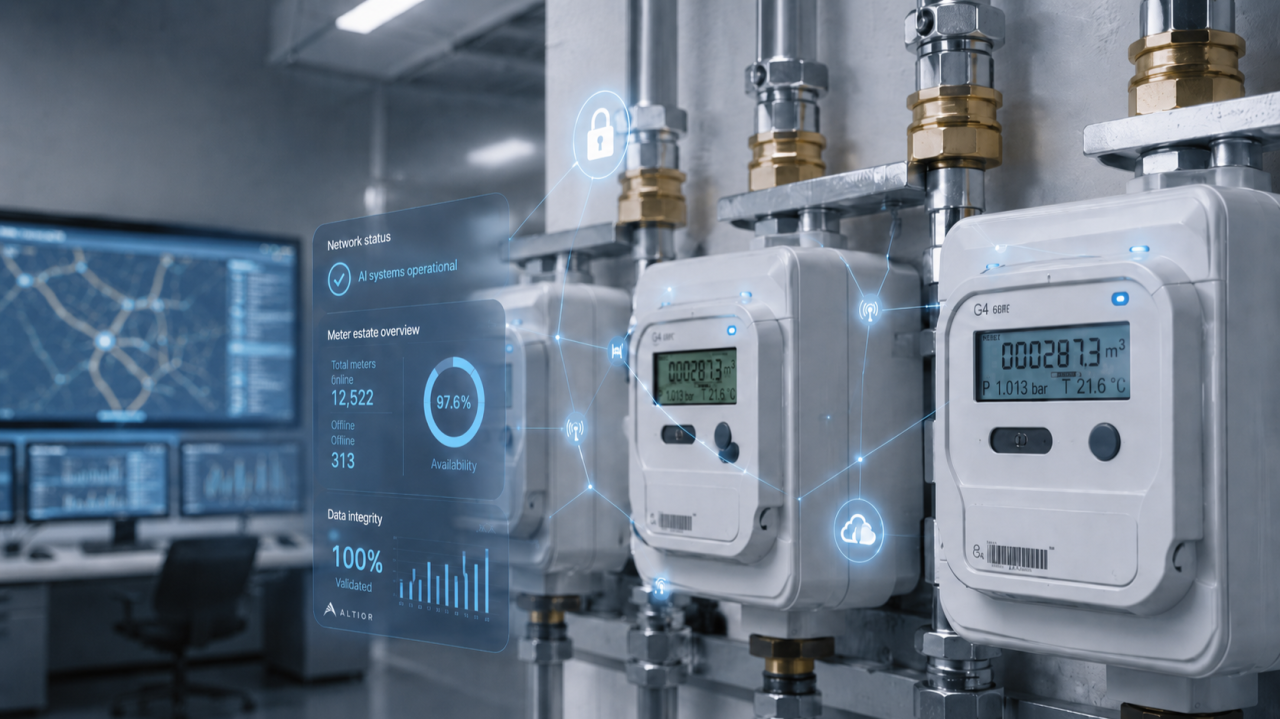
Major regulated programmes across Italy, France and the UK have proven that connected gas metering works. They have improved billing accuracy, reduced manual reads, expanded customer access to consumption data and created the foundations for more digital gas networks.
Italy was an important early proof point. Its large-scale regulated rollout showed that smart gas metering could work nationally, not only as a metering upgrade, but as a managed infrastructure programme.
It helped shape how European operators, OEMs and regulators approached deployment, certification, communications and interoperability, with our own co-founder and CTO, Massimo Cèsaro, directly involved in the European technical work on smart gas meter interoperability.
With smart metering programmes now maturing, the focus is shifting from connectivity and precise billing towards long-term estate management.
That shift is being accelerated by regulation. Smart gas meter estates are no longer just metering assets. They are part of critical operational infrastructure. Under NIS2, the Cyber Resilience Act, GDPR and national smart metering frameworks, utilities and their suppliers face growing scrutiny around cybersecurity, supply-chain resilience, data governance, auditability and operational continuity.
This matters for national operators with millions of meters. It also matters for regional distributors with a few hundred thousand. The compliance bar is increasingly similar; the available internal capacity is not.
Two starting points, one platform problem
Most OEMs, utilities and service providers start from one of two positions.
Smaller and mid-sized operators, and the OEMs selling to them, often have no HES or MDM layer, or one designed for a narrower role than they now require. They need a platform that can act as the head-end, manage the meter estate and bring in adjacent operational data such as pressure, odorisation, cathodic protection, environmental sensors and network telemetry.
Building that from scratch is slow, expensive and difficult to keep compliant.
Larger operators usually already have an MDM and billing system that work. Their challenge is the exception-handling, observability, validation and audit burden that comes with an estate in the millions. They need to make existing infrastructure more manageable and more defensible to regulators.
Both starting points lead to the same need: a platform that can act as the operational foundation where needed, and as a lightweight extension where core systems are already in place.
This is where Inkwell Data’s OT-IT PaaS, Altior, is designed to help.
From ingestion to state-aware operations
Traditional IT systems are built around request-response behaviour. If a billing system, ERP or analytics platform needs a value, it queries the source.
That works for servers, databases and cloud applications. It fits less naturally with battery-powered gas and water meters deployed at scale.
A smart meter is often hard to reach, connected through constrained networks such as NB-IoT, LoRaWAN, Wize or wM-Bus, and expected to operate for 10, 15 or even 20 years with minimal physical intervention. It is also part of a regulated and safety-critical environment.
As estates grow, a synchronous “pull” model becomes expensive and fragile. Radios that listen too often drain battery. Large polling sweeps create network congestion and low-value traffic. Inbound paths expand the cybersecurity surface of devices now treated as part of critical infrastructure.
For gas meter estates, a better model is required: the physical device remains quiet for as long as possible, while the operational platform remains intelligent all the time.
Push-only at the edge
Altior supports push-only integration patterns.
In a push-only architecture, the physical edge device does not behave like a permanently available IT endpoint. It wakes according to its approved communication cycle, or when a defined event occurs. It sends a compact, encrypted telemetry packet, receives any authorised acknowledgement or queued instruction within that window, then returns to sleep.
That pattern preserves battery life, reduces unnecessary radio activity, limits inbound exposure and supports a cleaner OT-IT boundary under regulatory regimes such as NIS2 and the CRA.
State-aware digital twins, beyond the meter
If the physical device is asleep most of the time, enterprise systems should not query the sleeping meter. They should query its state.
Altior maintains a state-aware digital representation of each device in the estate. That digital twin can hold the latest validated reading, device status, battery indicators, configuration, firmware version, communication history, event history, alarm state, installation metadata and operational context.
The model also extends to pressure sensors, odorisation monitoring, cathodic protection, gas quality sensors and other network telemetry that sits alongside the metering estate. For an OEM or operator building a platform from the ground up, this means one governed data layer rather than a separate silo for every device type.
Enterprise systems interact with governed digital state rather than trying to reach the physical device directly. Billing retrieves the last validated read. Analytics processes estate-level trends. Field service checks whether a fault is recurring. Asset management reviews battery-risk cohorts. Network operations correlates pressure anomalies with clusters of failed reads. Compliance teams access audit evidence.
If a configuration change is needed, it can be queued against the twin and delivered during the device’s next approved communication window. The change is not forced onto a sleeping device.
This decoupling makes push-only practical. Physical communication happens on the device’s terms, respecting battery, network and safety constraints. Enterprise logic runs continuously against the digital state.
It also supports compliance. A state-aware twin with full event history becomes an operational audit trail: readings, alarms, configuration changes, device status and routing decisions are timestamped and traceable.
Event-driven data routing
Metering estates generate many kinds of events: billing, operational, customer-service, cyber, compliance and field-service events, plus events from non-metering sensors on the same network.
Altior classifies, enriches and routes each event based on state and context.
A successful read goes to billing or MDM. A failed read is correlated with signal quality, gateway status and prior failures. A suspected battery issue goes to asset management. A tamper alarm goes to the appropriate operational workflow. A pressure or odorisation anomaly goes to network operations. A regulatory event is stored with a secure audit trail.
This avoids pushing every data point into every system. The right data reaches the right place, in the right format, at the right time.
One platform, two deployment models
Altior is designed to support existing smart metering architectures.
Where the full stack does not exist yet, Altior can act as the HES and MDM layer. It onboards devices, manages state, handles protocol translation, applies rules and exposes secure APIs to billing, CRM and reporting. Non-metering data joins the same governed platform from day one.
Where the full stack already exists, Altior sits above it as a secure operational data layer, protocol translation layer, estate-management dashboard, event-routing engine or white-label digital services platform. The goal is to make the estate more manageable without disturbing the regulated core.
The same platform can provide the foundation where needed, or strengthen what is already there. Altior can be deployed on-premise, in a private cloud, on tailored virtual private servers or in hybrid environments. For utilities affected by NIS2 supply-chain scrutiny and national data-sovereignty expectations, that flexibility matters at any scale.
Supporting OEMs, utilities and platform providers
For gas meter OEMs, the market is moving beyond the compliant device.
Utilities increasingly expect the supply chain to provide the digital operating model around the meter: onboarding, diagnostics, firmware visibility, battery intelligence, event handling, secure APIs, field evidence and integration into utility systems.
That creates a capital allocation problem. As gas networks prepare for biomethane, hydrogen blending and, in some markets, dedicated hydrogen infrastructure, OEM engineering effort is needed on measurement accuracy, materials, safety and certification. It should not be absorbed by rebuilding a utility-grade software stack differently for every customer.
Altior removes that digital capex burden.
Its modular architecture allows OEMs to offer a richer digital proposition without having to build and maintain the full platform themselves. It can be white-labelled, support multiple protocols, connect to existing HES, MDM, billing and operational systems, or provide those functions where they are missing.
It also adapts as business and regulatory needs evolve. Dynamic operational logic, event routing and state management sit in the governed digital twin layer, helping physical device firmware remain stable. That matters because unnecessary device-side changes can create additional testing, assurance and certification burden under legal metrology and connected-product regulation.
For utilities and gas distribution operators, the value is practical. Altior improves visibility across failed reads, silent meters, battery risk, communications performance, gateway and concentrator health, firmware status, configuration history, field interventions, customer disputes and regulatory evidence.
The standard meter read is rarely the expensive part. The expensive part is the exception: the missing read, repeated fault, unnecessary truck roll, manual investigation, unresolved customer issue or poor diagnosis before dispatch.
Altior helps reduce those costs by making the estate observable, routing events intelligently and allowing the platform to evolve with the operator’s commercial, technical and regulatory requirements.
Interoperability across fragmented markets
European and UK gas metering will not converge onto one architecture.
For OEMs and service providers, smart gas metering cannot be treated as a single-market, single-scale software problem. Different markets combine Wize, OMS, wM-Bus, DLMS/COSEM, LoRaWAN, NB-IoT, cellular, proprietary payloads, national data hubs and utility-specific head-end systems in different ways.
Altior helps by decoupling the device estate from the application estate. It ingests data from multiple protocols, normalises it, applies rules, maintains device state and exposes secure APIs to downstream systems.
That lets OEMs, utilities and service providers support different national architectures and customer sizes without rebuilding the integration stack each time.
The value is in making different models and starting points work together on the same platform.
Final Thoughts: from successful rollout to sustainable operation
Smart gas metering has been one of Europe’s most important utility digitalisation initiatives. It has delivered clear benefits: more accurate billing, fewer manual reads, better customer data, improved network visibility and the foundations for more intelligent gas infrastructure.
Adoption will continue to expand. But success brings the next set of challenges.
As smart gas meter estates age, batteries drain, communications performance changes, devices become harder to manage, and operational exceptions increase. At the same time, the infrastructure around those meters is being asked to do more: support new data services, withstand growing cyber risk, provide stronger audit evidence and adapt to changing regulatory expectations.
The question is no longer only how to connect the meter. It is how to keep the estate secure, observable, interoperable and cost-effective over its full life.
That is where Altior fits.
Altior was built to complement what has already been deployed. It can sit above existing HES and MDM systems, or provide those capabilities where they are missing. It helps OEMs and utilities manage state, route events, reduce exceptions, preserve device life and provide the operational evidence increasingly expected by regulators.
This is a partnership model. Altior supports meter OEMs and their end users by extending the value of existing smart gas infrastructure and helping accelerate adoption without forcing each market, operator or manufacturer to rebuild the same digital layer from scratch.
The next phase of smart gas metering will be about sustainable operation. Altior gives OEMs, utilities and service providers a practical way to move from connected meters to managed, secure and interoperable estates.