
SensorWise: Improving Operational Data Quality for Trusted Scope 1, 2 & 3 Reporting

By late 2025, organisations across manufacturing, utilities, logistics and real estate are operating in an increasingly demanding environment for operational data.
Expectations around sustainability reporting, operational transparency and cybersecurity have grown significantly. ESG reporting is shifting from annual summaries to continuous, data-led disclosure. Boards and investors now ask whether operational data is complete, governed and suitable for analytics and AI. Meanwhile, buildings, plants and networks are becoming more connected, creating new requirements for data quality and OT–IT integration.
This combination of pressures has created a common challenge: how to collect, structure and govern operational data well enough to support modern ESG reporting and regulatory requirements—without introducing unnecessary complexity or replacing established systems.
SensorWise, built on the Altior OT data architecture, addresses this challenge directly. Rather than displacing existing platforms, it adds a flexible monitoring and governance layer that improves data quality at source and delivers clear, auditable information to the systems organisations already rely on.
A More Demanding Regulatory Landscape
Regulatory frameworks have advanced quickly in recent years. In Europe, the Corporate Sustainability Reporting Directive (CSRD) and ESRS standards now apply to the largest companies, with many mid-sized organisations entering the regime for their 2026 reporting year. These standards require reliable, disaggregated data across Scope 1, Scope 2 and, where material, Scope 3 emissions.
Alongside this, the NIS2 Directive sets higher expectations for how operational data is collected, routed and logged across essential services and critical infrastructure.
In the UK, climate disclosures aligned with TCFD continue to mature, especially across infrastructure, regulated utilities and large property portfolios. In North America, investor expectations for emissions data often exceed local regulatory requirements, making reliable operational telemetry increasingly important.
Global supply chains amplify these pressures: many OEMs, retailers and utility operators now expect emissions and environmental data from suppliers, creating indirect obligations across a broad range of industries.
Who These Changes Affect Most
The organisations most affected tend to have substantial operational footprints:
Industrial and manufacturing sites, where continuous insight into energy, process and environmental conditions supports both compliance and production performance
Utilities, where network telemetry underpins regulatory submissions and asset planning
Real-estate portfolios and facilities managers, responsible for site-level data on HVAC, occupancy and environmental conditions
Logistics and warehousing operators, particularly those managing cold chains or distribution environments requiring in-transit environmental data
Across these settings, legacy systems typically provide partial or inconsistent data, making it difficult to meet expanding reporting requirements.
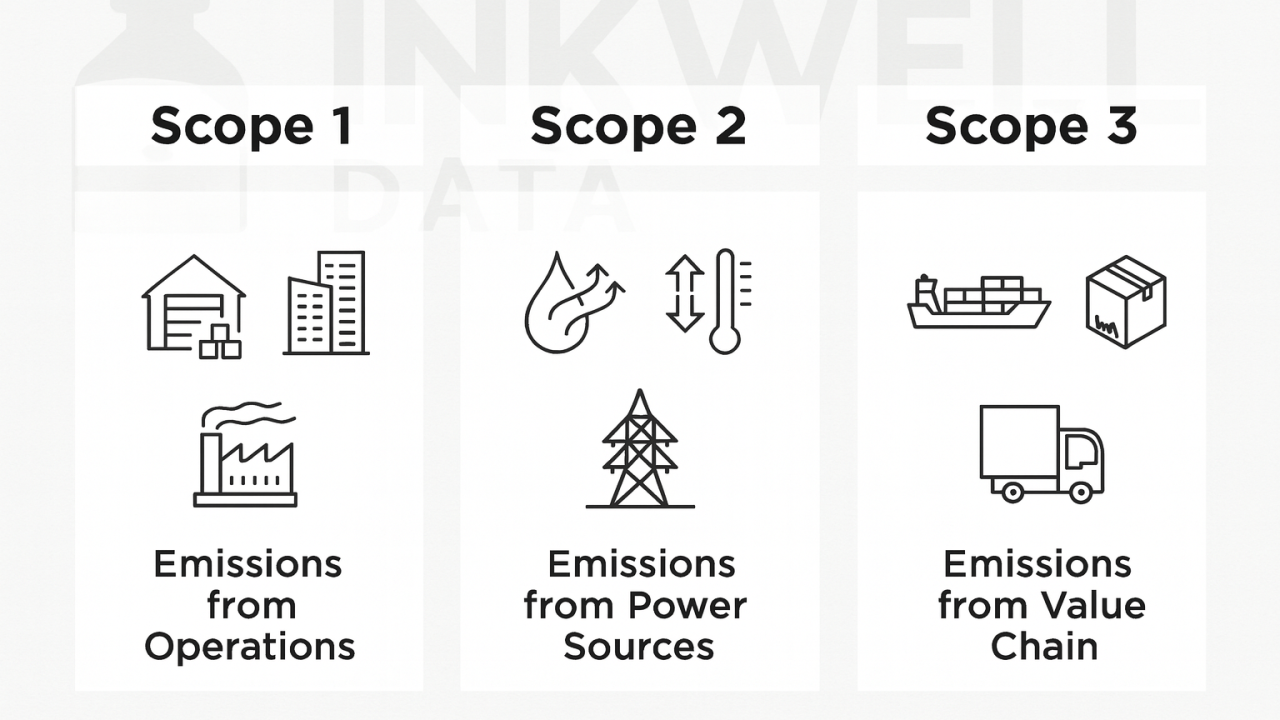
Understanding Scope 1, Scope 2 and Scope 3
Effective sustainability reporting begins with a clear understanding of the three emissions categories:
How SensorWise Strengthens Scope 1, 2 & 3 Reporting
Reliable Scope 1 & 2 Telemetry
SensorWise provides continuous real-time readings for:
• energy consumption
• HVAC and process performance
• indoor environmental conditions
• air quality
• occupancy and activity
• leak, flow and pressure conditions
• equipment runtime and efficiency
All readings are validated through Altior's event-driven governance layer, creating consistent, traceable and auditable data suitable for ESG reporting and external assurance.
Supporting Scope 3 with Operational Intelligence
SensorWise enhances the quality of data used for several Scope 3 categories, including:
• environmental data around waste handling
• occupancy data for commuting and hybrid-working models
• telemetry from leased facilities
• asset-tracking and environmental conditions during transit (including cold-chain)
• performance data during the operational life of sold products
• supplier and partner data feeds brought into a unified model via Altior
SensorWise does not replace specialist Scope 3 calculation tools but significantly improves the reliability and richness of the underlying data they depend on.
SensorWise as a Dashboard and Alarm Environment
A key advantage of SensorWise is that it can function as a complete operational dashboard, providing:
• real-time visualisation through floor plans and GPS maps
• customisable alarms across any combination of devices, vendors or technologies
• rules based on thresholds, sequences or multi-sensor patterns
• auditable logs and metadata for every data point and alarm event
• historical replay for analysis, reporting and assurance
This creates a clear, consistent and governance-ready view of operational performance, helping organisations simplify ESG reporting and respond quickly to operational issues.
Routing Data to Existing Enterprise Platforms
For organisations already invested in operational or ESG systems, SensorWise can sit in the background and ensure those platforms receive clean, structured data. It integrates easily with:
• CMMS tools such as Limble
• enterprise digital twins
• BMS and EMS systems
• ITSM and workflow platforms
• analytics and predictive models
Data can be delivered via MQTT, Kafka, AMQP or REST, enabling organisations to preserve their existing workflows while improving data quality at source.
A Practical OT–IT Bridge
Most organisations operate a mixture of OT systems—modern IoT sensors, legacy automation equipment, building-management systems and discrete tracking tools. SensorWise provides a coherent way to unify these environments.
Data enters via Altior, is enriched and validated by SensorWise, and can flow either into the dashboard environment or to external systems. This approach reduces reliance on bespoke integrations and supports a more orderly progression towards digital-ready OT–IT infrastructure.
Deployment Options
SensorWise can be deployed:
• on-premises or in private cloud using a lightweight VM footprint
• as SaaS/PaaS through SWaRM
• in hybrid OT–IT environments
The architecture avoids hyperscaler dependence, supporting sovereignty, predictable cost and simpler governance.
Preparing for Reporting Cycles in 2026 and Beyond
As organisations prepare for their next ESG disclosures—many of which fall in 2026 and 2027—several patterns are emerging:
• continuous operational telemetry is becoming the norm for Scope 1 and 2
• Scope 3 reporting increasingly requires measured inputs rather than estimates
• digital twins and ESG platforms rely on consistent OT data flows
• auditors expect clear data lineage, routing logs and control mechanisms
• OT monitoring must align with NIS2 requirements for security and resilience
Organisations investing early will be better placed to adapt to these expectations. Those who delay may find it increasingly difficult to meet the data standards set by regulators, auditors and supply-chain partners.
A Reliable Basis for ESG and Operational Transparency
SensorWise offers a practical way to modernise operational data without disrupting established systems. It strengthens Scope 1 and 2 reporting through continuous telemetry, improves Scope 3 data by adding context and structure, and provides a clear governance framework across OT environments.